
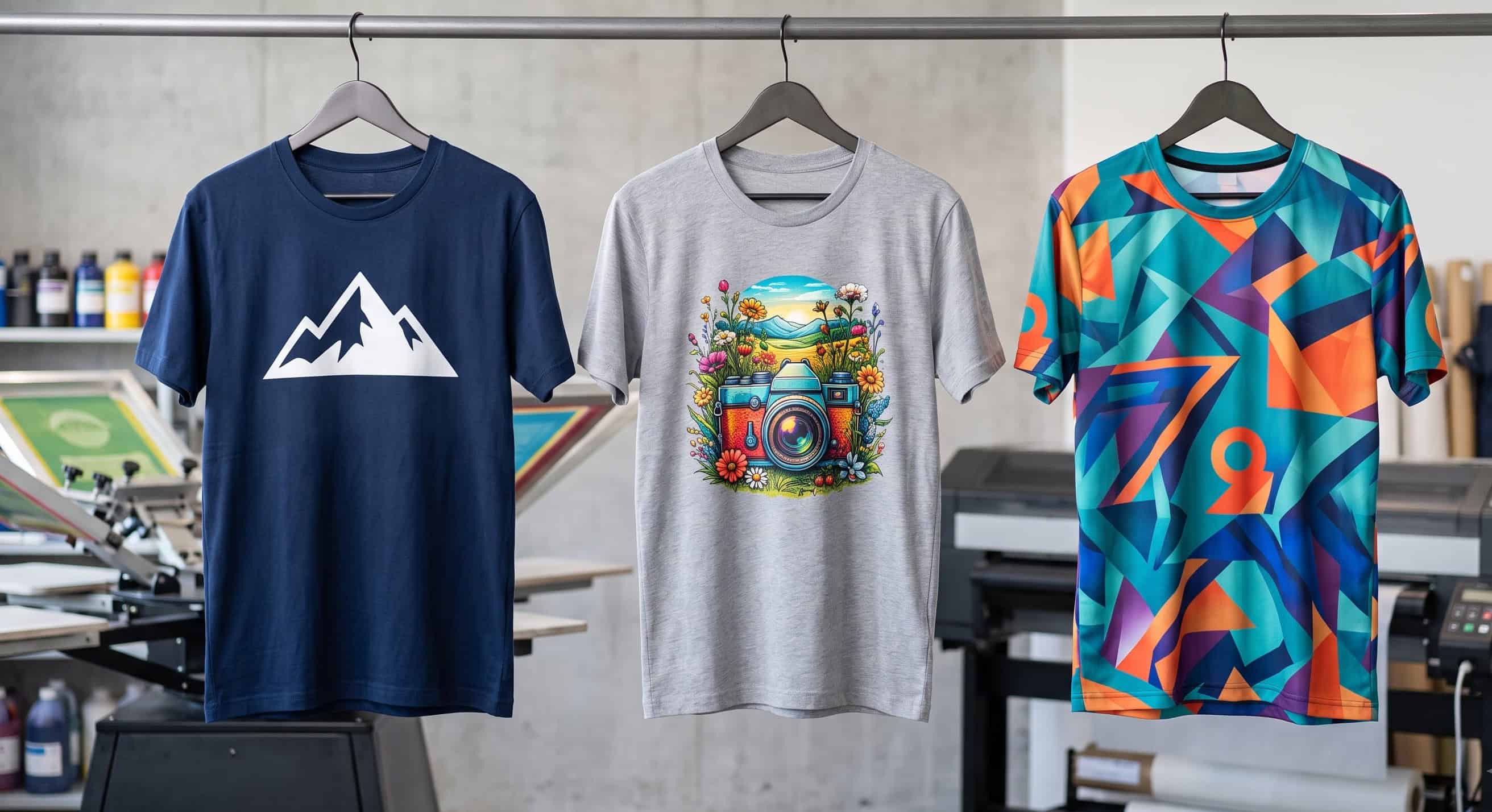
"Printing" on garments isn't one thing. There are three common methods, and they're genuinely different: different costs, different looks, different fabrics they work on. Pick the right one and your job looks great for the right price. Pick the wrong one and you either overpay or end up with a print that doesn't suit the garment.
Here's a plain-English guide to screen printing, DTF and sublimation, and how to tell which your job needs.
Screen printing: the volume champion
Screen printing forces ink through a stencil (a screen) onto the fabric, one colour at a time. Each colour needs its own screen and setup.
Best for: large runs of a simple design, usually one to three colours, on cotton or cotton-blend tees.
Why it wins there: the setup cost is fixed, so the more shirts you print, the less each one carries. On a big order of basic tees, nothing beats it on price. The finish is classic and durable on cotton.
Where it struggles: small runs (the setup cost makes each shirt expensive), and designs with lots of colours, fine detail, gradients or photographs (each colour adds a screen and cost).
DTF: the flexible all-rounder
DTF, or direct to film, prints your full-colour design onto a special film, then heat-presses it onto the garment. There's no separate setup per colour.
Best for: full-colour or detailed designs, photographs, and small to medium runs. It works on cotton, polyester and blends, and on light or dark garments.
Why it wins there: because there's no per-colour setup, a detailed ten-colour design costs the same to set up as a one-colour one. That makes small runs and complex artwork affordable, which is exactly where screen printing gets expensive.
Where it struggles: on very large runs of a simple design, screen printing can still be cheaper per unit. And a large, solid DTF print can feel a little heavier on the fabric than a fine screen print.
Sublimation: for all-over, vivid designs
Sublimation uses heat to turn dye into a gas that bonds into polyester fabric. The design becomes part of the cloth, with no print sitting on top.
Best for: all-over, bright designs on white or light polyester, most commonly sports and team uniforms.
Why it wins there: the colours are vivid and permanent, the whole garment can be printed edge to edge, and there's nothing to crack or peel because the dye is in the fabric. Names, numbers and multiple sponsors all go in as part of the one design at no extra per-colour cost.
Where it struggles: it only works well on white or light polyester. It can't print onto cotton, and it won't show up on dark fabrics. So it's brilliant for sports strip and wrong for a cotton tee.
A side-by-side comparison
| Feature | Screen printing | DTF | Sublimation |
|---|---|---|---|
| Best run size | Large | Small to large | Small to large |
| Full colour / photos | Limited | Excellent | Excellent |
| Fabric | Cotton, blends | Cotton, poly, blends | Light polyester only |
| Dark garments | Yes (with underbase) | Yes | No |
| All-over print | No | No | Yes |
| Cost on big simple runs | Cheapest | Higher | N/A |
| Feel on garment | Light (fine prints) | Slight layer | None (dyed in) |
How to choose for your job
Ask three questions:
1. How many are you printing? Big run of a simple design → lean screen printing. Small run → lean DTF. 2. How detailed or colourful is the design? Full colour, photographic or fine detail → DTF (or sublimation if it's all-over on poly). Simple one to three colours → screen printing. 3. What's the garment? Cotton tees → screen or DTF. Light polyester sports tops with all-over designs → sublimation.
If your answers point in different directions, that's normal. Describe the job to a decorator who runs all three and let them recommend, rather than being sold whatever one machine they own.
Common mistakes
Ordering a small screen-print run. The setup makes it pricey per shirt. For small numbers, DTF is usually cheaper and handles more detail.
Trying to sublimate cotton. It won't work. Sublimation needs light polyester.
Expecting a bright print on a dark shirt with sublimation. It won't show. Dark garments need DTF or screen printing with an underbase.
Choosing on price alone. The cheapest method for the quantity might not suit the garment or design. Match the method to the whole job.
Best practice: let the job decide
There's no single best printing method, only the best one for your combination of quantity, design and garment. Screen printing owns big simple runs. DTF owns detail and small runs. Sublimation owns all-over designs on sports poly. A decorator with all three will give you an honest recommendation, because they're not limited to one option.